


Being skinny in Nigeria is treated as either a compliment or an insult, depending on who’s talking. In some places, people say you look ‘fresh.’ In others, your aunt grabs your arm at a family gathering and announces to the room that you need to eat more.
Somewhere in between, there are thousands of Nigerians, men and women, who genuinely want to gain weight. Most can’t figure out why it’s not happening despite eating what feels like enormous amounts of food.
We’ve been in those conversations. We’ve heard the theories: fast metabolism, worms, stress, ‘your father was also like this.’ Some of these things are partially true. But most of them miss the actual reason.
Here’s our complete guide on how to gain weight fast in Nigeria using local food and without imported supplements. We’ll explain the science that most content leaves out completely.
Why You’re Not Gaining Weight: The Real Reason

Let’s start with the hard truth that most skinny Nigerians don’t want to hear. The primary reason you’re not gaining weight is almost certainly this: you’re not eating as much as you think you are.
We know how that sounds. You eat jollof rice, pounded yam and egusi, breakfast and lunch and dinner, and yet the scale doesn’t move.
Here’s what’s actually happening. Our bodies have a remarkable ability to compensate for extra food intake through something researchers call NEAT: non-exercise activity thermogenesis. This is all the movement you do that isn’t formal exercise: fidgeting, pacing, standing up more often, tapping your foot, walking more briskly.
When you eat more, your body unconsciously burns more through these small movements. It’s an adaptive response. Many naturally thin people (what fitness science calls ectomorphs, or ‘hardgainers’) have bodies that are especially good at this compensation. You eat more, and your body just burns more.
The second factor is portion perception. When we’ve worked with underweight Nigerians or spoken to people struggling to gain weight, there’s usually a consistent pattern. They describe their meals as large, but when they actually track the calories, the numbers tell a different story.
A plate of rice that feels enormous might be 500 calories. You need a surplus of 300 to 500 calories above your maintenance every single day to gain weight. If your maintenance is 2,200 calories, you need to eat 2,500 to 2,700 calories daily, consistently, for weeks.
| 💡 The maths of weight gain: One pound of body weight (roughly 0.45 kg) requires approximately 3,500 extra calories above your maintenance. To gain 0.5 kg per week, you need to eat 3,500 calories more than your body burns that week, which is a 500-calorie daily surplus. Research recommends a target of 0.25 to 0.5% of bodyweight per week for healthy weight gain. For a 55 kg person, that’s about 140 to 275 g of gain per week. |
The Nigerian-Specific Weight Gain Challenge
There are three challenges to gaining weight in Nigeria that you won’t find in articles not written for Nigerians. These include:
1. Our food culture doesn’t encourage constant eating
Nigerian meal culture is typically built around two or three proper meals a day. There’s no snack culture the way there is in the West: we don’t naturally reach for calorie-dense snacks between meals.
If you’re a hardgainer who needs 2,800 calories a day, getting that into two or three Nigerian meals means making each meal significantly larger than average. Many people find this physically uncomfortable.
The solution isn’t to force yourself to eat one enormous meal. It’s to add more eating occasions throughout the day.
2. Nigerian women and the ‘slim is beautiful’ pressure
Gaining weight as a Nigerian woman comes with social complexity that men don’t face in the same way. There’s a cultural window that some people describe as ‘the right kind of slim.’
For many women trying to gain weight, the goal is to add in specific places like the hips, thighs, and chest, while not gaining belly fat. We want to be direct: you cannot choose where your body stores weight. It’s just as you can’t pick where to lose weight first when burning fat.
Fat distribution is primarily genetic and hormonal. What you can choose is whether the weight you gain is mostly fat or mostly muscle. Strength training determines which one you get.
3. The worm theory and other misconceptions
The idea that ‘you have worms’ is responsible for not being able to gain weight is deep in Nigerian folklore. Intestinal parasites are a real health concern in Nigeria and can genuinely affect nutrient absorption.
If you’ve never been dewormed as an adult and you live in Nigeria, it’s worth speaking to a doctor. But for the majority of underweight Nigerians, worms are not the primary cause.
Chronic stress, lack of sleep, underlying thyroid issues, and simply not eating enough calories are far more likely reasons. Get a proper medical check first if you’ve been struggling for years with no change.
The Nigerian Foods That Build Weight (With Real Calorie Numbers)
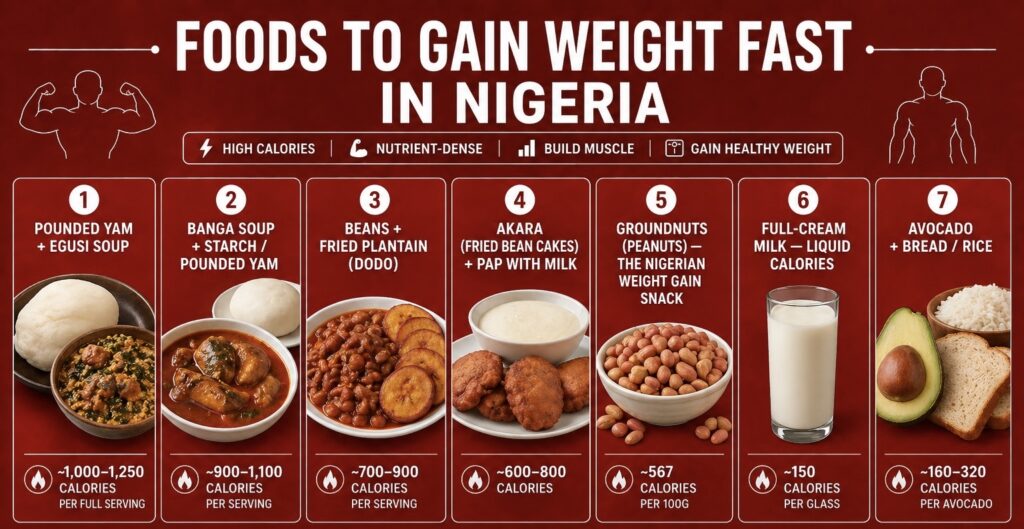
Much content on how to gain weight fast in Nigeria tells you to eat more without saying the calorie density of specific foods. We’re fixing that. Here are our research-based recommendations:
| Pounded Yam + Egusi Soup ~1,000–1,250 calories per full serving |
| Why it works: This combination is one of the highest-calorie traditional Nigerian meals. Two cups of pounded yam alone carry about 800 calories. One cup of egusi soup adds another 450 to 600 calories, depending on how much palm oil was used and what meats are inside. For a hardgainer, this is one meal that can deliver almost half your daily calorie target in a single sitting.How to use it: Eat this twice a week at a minimum. Don’t be tempted to reduce the portion because you’re watching your shape: this is exactly what you need. Add a full piece of assorted meat and stockfish to the soup for extra protein and calories. |
| Banga Soup + Starch / Pounded Yam ~900–1,100 calories per serving |
| Why it works: Banga soup is made from palm nut extract, which is naturally high in fat and calories. A standard bowl of banga soup has around 440 calories from the soup alone before swallowing. Paired with a medium ball of starch or pounded yam, this becomes a very calorie-dense Nigerian meal. It’s particularly popular in Delta, Rivers, Bayelsa, and Edo states.How to use it: If you’re from the Niger Delta region or have access to banga concentrate in your market, this is your highest-calorie everyday meal. Cook it with fish, chicken, periwinkle, and assorted meats together for maximum protein alongside the calorie load. |
| Beans + Fried Plantain (Dodo) ~700–900 calories per serving |
| Why it works: A cup of beans cooked with palm oil carries about 520 calories. Add a portion of fried ripe plantain, and you’re at 700 to 900 calories for one meal that’s also high in protein (from beans) and complex carbohydrates. This combination is widely available across Nigeria and extremely affordable.How to use it: Make the beans thick: cook them with more palm oil than you would for weight loss cooking. Fry the plantain instead of boiling. Eat with akara on the side if you can manage it. |
| Akara (Fried Bean Cakes) + Pap with Milk ~600–800 calories |
| Why it works: This classic Nigerian breakfast is a calorie-dense way to start the day. Six akara pieces provide around 350 to 400 calories. A bowl of pap mixed with full-cream milk and a tablespoon of sugar adds another 250 to 350 calories. Together, this breakfast puts you at 600 to 800 calories before 9 AM, which is excellent for a hardgainer.How to use it: Don’t use Nutrend or low-fat milk. Use full-cream Peak or Three Crowns. Add more milk than water to the pap. The more calorie-dense you make this morning combination, the better it works for weight gain. |
| Groundnuts (Peanuts) — The Nigerian Weight Gain Snack ~567 calories per 100g |
| Why it works: Groundnuts are one of the most calorie-dense foods available in Nigeria, and they’re sold everywhere: street hawkers, markets, and provision stores. 100g of groundnuts carries 567 calories and 25 grams of protein. They’re portable, they don’t require cooking, and you can eat them between meals without disrupting your appetite for the next proper meal.How to use it: Carry a small bag of roasted groundnuts with you everywhere. Eat a handful between meals — mid-morning and mid-afternoon. This adds 300 to 400 extra calories to your day without you having to sit down for another full meal. This is one of the most practical tools for hardgainers in Nigeria. |
| Full-Cream Milk — Liquid Calories ~150 calories per glass |
| Why it works: Here’s a tactic that many hardgainers overlook: liquid calories don’t fill you up the way solid food does. A glass of full-cream milk with Milo or Ovaltine gives you 200 to 300 calories without reducing your appetite for the next meal. For a hardgainer with a small stomach who struggles to eat large portions, adding liquid calories is one of the smartest strategies available.How to use it: Replace water with full-cream milk at meals and between meals. Add Milo or Ovaltine generously. You can also blend peanut butter (groundnut paste) into a glass of milk for a 400-calorie drink that takes 60 seconds to make. Peak milk powder is available in every provision store in Nigeria. |
| Avocado + Bread / Rice ~160–320 calories per avocado |
| Why it works: Avocados have become more widely available across Nigerian markets in recent years, especially in the south and Middle Belt. A medium avocado carries around 160 calories, nearly all from healthy monounsaturated fat. Mashed onto bread or eaten alongside rice, it adds meaningful calories without making your meal feel significantly heavier.How to use it: Buy avocados from Mile 1, Mile 3, Oil Mill Market in PH, or any major Lagos market when they’re in season. They’re cheap and calorie-dense. Mash them with a pinch of salt and spread on Agege bread for a simple high-calorie snack. |
The 7-Day Nigerian Weight Gain Meal Plan
How to gain weight without supplements in Nigeria starts with this: eating more Nigerian food often. That said, you must do it strategically.
Here’s what a full day looks like with a calorie target of approximately 2,800 to 3,000 calories for a 60kg hardgainer:
| Sample Day — 2,800 to 3,000 Calories (Nigerian Hardgainer) | |||
| Time | Meal | Calories | Notes |
| 7:00 AM | Akara (6 pieces) + pap with full-cream milk + 2 boiled eggs | ~750 cal | Full-cream milk, not water in pap |
| 10:30 AM | Roasted groundnuts + 1 ripe banana + glass of Milo (full-cream) | ~450 cal | Mid-morning snack |
| 1:30 PM | Pounded yam (2 medium balls) + egusi soup (full bowl) + assorted meat | ~1,100 cal | Don’t reduce portion |
| 4:30 PM | Bread (2 slices) + groundnut paste (peanut butter) + full-cream milk | ~350 cal | Afternoon snack |
| 7:30 PM | Rice + stew + fried plantain + chicken | ~750 cal | Close the day strongly |
That’s five eating occasions across the day. Three main meals and two snacks. The total is approximately 3,400 calories: a meaningful surplus above most Nigerian adults’ maintenance. Do this consistently for six to eight weeks, and the scale will move.
The Role of Exercise: Specifically for Weight Gain
We want to address a common mistake: people trying to gain weight who do too much cardio.
Stuff like running, football, and vigorous cardio burns the calories you’re working to accumulate. A hardgainer who runs every morning and then struggles to eat enough is working against themselves.
Cardio has cardiovascular health benefits that matter. However, if your primary goal right now is to gain weight, limit cardio to two or three short sessions per week maximum.
What you should be doing instead: strength training
Resistance exercise (squats, push-ups, pull-ups, bench press) provides the stimulus that directs your calorie surplus toward building muscle rather than just fat.
Research published in the PMC bodybuilding nutrition review found that a calorie surplus of 200 to 500 calories combined with resistance training is more effective at building lean mass than a large surplus without training.
The gym fee in Nigeria is now ₦20,000 to ₦60,000 per month. However, push-ups, squats, lunges, and planks at home cost nothing and provide meaningful stimulation for beginners.
What About Supplements, Do You Need Them?

Gaining weight without supplements in Nigeria is entirely possible. Most Nigerians who’ve successfully gained weight did it this way. Supplements are not necessary: they’re convenient, but they’re not magic.
Mass gainer supplements are essentially powdered carbohydrates and protein with flavouring. They’re expensive (₦40,000 to ₦80,000 per container), and you can get the same calories and protein from Nigerian food for a fraction of the price.
One tin of Peak full-cream milk powder, a bag of groundnuts, and a carton of eggs will get you further than most mass gainers at a quarter of the cost.
If you want to use one supplement, we recommend Creatine Monohydrate. It’s cheap (₦8,000 to ₦15,000 for a month’s supply), well-researched, and causes your muscles to retain water. That means you’ll see a genuine increase on the scale within the first week of use (3 to 4kg for most people).
The gain with creatine isn’t fat or muscle. It’s intramuscular water, but for a hardgainer who’s been watching the scale refuse to move for months, this initial response is motivating and sustains consistency. Creatine also improves strength training performance over time.
What to Know as a Nigerian Woman Trying to Gain Weight

Gaining weight as a Nigerian woman comes with a layer of social complexity that we want to address directly. The female body, under the influence of estrogen, tends to store fat in the hips, thighs, and chest first, before the belly and other areas.
In other words, the healthy, consistent calorie surplus in a woman will, over time, produce the fuller figure that many Nigerian women want. But it requires patience. The process is slow: even in ideal conditions, gaining 0.5 to 1kg of actual body mass per month is realistic and healthy.
Based on our research, the things that slow weight gain in Nigerian women are mainly:
- High stress (cortisol breaks down muscle and disrupts appetite)
- Skipping meals because of busy schedules
- Drinking too much water and not enough calorie-containing drinks
- Cultural pressure to stay slim makes some women unconsciously eat less than they intend to.
If you want to reverse the effects, here’s what to do instead:
- Eat breakfast every day: Don’t leave the house without eating. Akara and pap take 10 minutes. Bread and groundnut paste take three.
- Eat full-cream dairy: Full-cream milk, full-cream yoghurt. Not the ‘slim’ or ‘low-fat’ versions.
- Eat between meals: Groundnuts, ripe plantain, boiled corn with coconut, and chin-chin in moderation. These are all calorie-dense Nigerian snacks.
- Don’t do excessive cardio: If weight gain is the goal right now, reduce the aerobics and Zumba classes to twice a week maximum and focus on eating more.
- Sleep: Growth hormone, which drives muscle growth and weight gain, is primarily released during deep sleep. Seven to nine hours is not a luxury. It’s part of the weight gain protocol.
Final Word from Our Guide
Gaining weight in Nigeria without supplements is a food game. The foods that build weight are already in your market and in your kitchen. These are pounded yam and egusi, banga soup, beans and fried plantain, akara and pap, groundnuts, full-cream milk, and avocados.
The reason most Nigerians fail to gain weight isn’t a lack of effort or a broken metabolism. It’s a mix of underestimating how many calories are actually needed, eating too infrequently, and burning more than they realise.
Fix the calorie math, eat five times a day, and add strength training. Then, sleep properly, and in eight to twelve weeks, the scale will tell a different story.
The people around you who ‘eat everything and never gain weight’ are almost certainly eating less than they think and moving more than they realise. You can work around both of those things. It just takes a deliberate strategy and consistency with it.