


In this piece, we’re sticking strictly to numbers from Nigerian and Africa-focused research. Just what the studies say about low-calorie Nigerian foods and how they fit into a smart eating plan.
Any time the topic of weight loss comes up in a Nigerian setting, one of the first things people say is: “our food is too heavy.” And we understand why. When your everyday meals include eba, pounded yam, ofe onugbu, egusi, and jollof rice, the calorie count can feel like it’s working against you.
But here is the thing: Nigerian food is not inherently fattening. What matters is what is in it, how it is prepared, and how much of it you eat. And we don’t have to guess about any of this, because Nigerian researchers have studied the calorie and nutrient content of our foods for decades.
Our Staple Foods Are Lower in Calories Than You Think
One of the most cited Nigerian nutrition studies looked at the proximate composition and energy values of yam, cassava, cocoyam, and maize from communities in Rivers and Bayelsa States. The researchers, Onyeike, Akaninwor, and Ifemeje from the University of Port Harcourt and Anambra State University, published their findings in Biokemistri (2008).
Their data showed that our most common staples carry far fewer calories per 100 grams than many people assume:
| Food | State (kcal/100g) | Energy value |
| Yam | Raw | ~140–149 kcal |
| Yam | Cooked | ~129–138 kcal |
| Cassava | Raw | ~142–149 kcal |
| Garri (eba) | Processed | ~125–132 kcal |
| Fufu | Processed | ~118–138 kcal |
| Cocoyam | Raw | ~124–130 kcal |
| Cocoyam | Cooked | ~118–127 kcal |
| Maize | Raw | ~174–210 kcal |
| Maize | Cooked | ~133–153 kcal |
Source: Onyeike, Akaninwor & Ifemeje, Biokemistri 20(1):1–9, 2008.
These numbers are quite moderate. For context, the researchers noted that none of these foods in isolation would meet an adult’s daily energy needs even at 350g per day. That tells you our staples are not calorie bombs by themselves. The issue is usually what we pair them with and how much palm oil, crayfish, stockfish, and protein goes into the soup or stew alongside.
The study also found that heat processing, that is, cooking, generally reduced the energy content compared to raw values. So your eba is not higher in calories than the raw cassava it came from; it is actually slightly lower.
Key takeaway: Yam, cassava, and cocoyam in their cooked forms come in at roughly 118–138 kcal per 100g. Maize is the highest of the group at around 133–153 kcal cooked. These numbers aren’t extreme on their own.
The Real Calorie Story Is in Our Soups
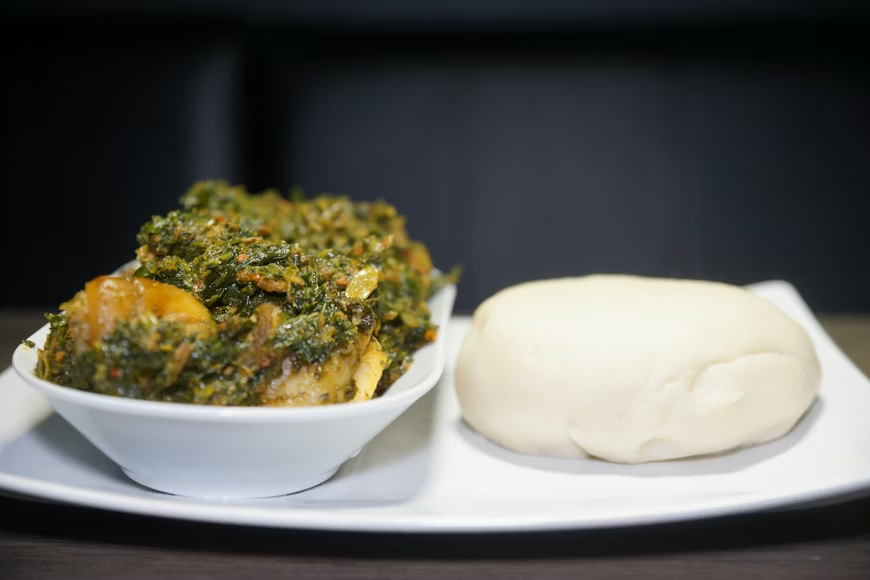
Our soups are where the numbers get more interesting and more variable. A comparative study published in the Ethiopian Journal of Health Development looked at the energy content of ten different Nigerian soups prepared in both rural and urban styles, measuring calories per 100 grams and per 150-gram serving.
The findings showed a wide range depending on the soup type and preparation. Here is how some of the key soups compared:
| Soup type | Urban (kcal/100g) | Per 150g serving |
| Okra soup (plain) | 357 kcal | ~672 kcal |
| Okra with ewedu | 537 kcal | ~744 kcal |
| Ewedu soup | 791 kcal | ~844 kcal |
| Okra, ewedu & melon seed | 614 kcal | ~850 kcal |
| Cowpea (gbegiri) | 680 kcal | ~874 kcal |
| Waterleaf with melon seed | 750 kcal | ~981 kcal |
| Plain melon seed soup | 872 kcal | ~1,106 kcal |
Source: Comparative study of nutrient composition of common Nigerian soups, Ethiopian Journal of Health Development.
The pattern here is clear. Plain okra soup was the lowest-calorie option at just 357 kcal per 100g in urban preparation; roughly half the energy of plain melon seed soup. The researchers found that fat, particularly from added oils and high-fat ingredients like melon seed (egusi), is the main driver of higher calorie content in soups. The more egusi or added oil in the preparation, the higher the calories.
This is why two people can eat “okra soup” and consume very different amounts of calories, depending on how much palm oil and egusi went into the pot.
Key takeaway: Plain okra soup and okra-ewedu combinations are the lowest-calorie soup options in this study. Melon seed-heavy soups (egusi) carry the highest calorie load. If you are watching your intake, your soup choice matters as much as your swallow choice.
Our Leafy Vegetables Are Low Calorie Powerhouses
A 2018 study from the Department of Food Science and Technology at Michael Okpara University of Agriculture, Umudike, by researchers Ukom and Obi, analyzed the nutrient and energy content of four common Nigerian leafy vegetables. Published in International Letters of Natural Sciences, the study reported the following energy values:
| Vegetable | Local name | Energy (kcal/100g) |
| African spinach | Inine / Tete | 341 kcal |
| Garden egg leaf | Okpokwa | 349 kcal |
| Bush mallow | Ahihara | 355 kcal |
| Ewedu (jute mallow) | Ewedu / Ayoyo | 363 kcal |
Source: Ukom & Obi, International Letters of Natural Sciences, Vol. 71, pp. 43–50, 2018.
These values are for raw vegetables by weight and fall comfortably in the low-calorie range. A separate study on Amaranthus hybridus (African spinach/green) published by researchers at Abia State University (Akubugwo et al., 2007 in the African Journal of Biotechnology) reported a value of about 269 kcal per 100g dry weight for the same vegetable, with the authors noting this compared favorably to other Nigerian vegetables, including afang leaf and sweet potato leaves.
The critical thing to understand about leafy vegetables is that they are mostly water. When you eat a portion of ugwu, waterleaf, or African spinach from your soup, the actual dry weight, and therefore the actual calorie contribution is small. Most of the calorie load in vegetable soups comes from the oil, crayfish, and proteins added during cooking, not from the leaves themselves.
Key takeaway: Nigerian leafy vegetables, ugwu, ewedu, waterleaf, African spinach, are inherently low in calories. They are also some of the most nutrient-dense items on our plates. The calories in vegetable soups come mainly from cooking fat and added ingredients, not the greens.
Full Nigerian Meals: Where the Calories Add Up
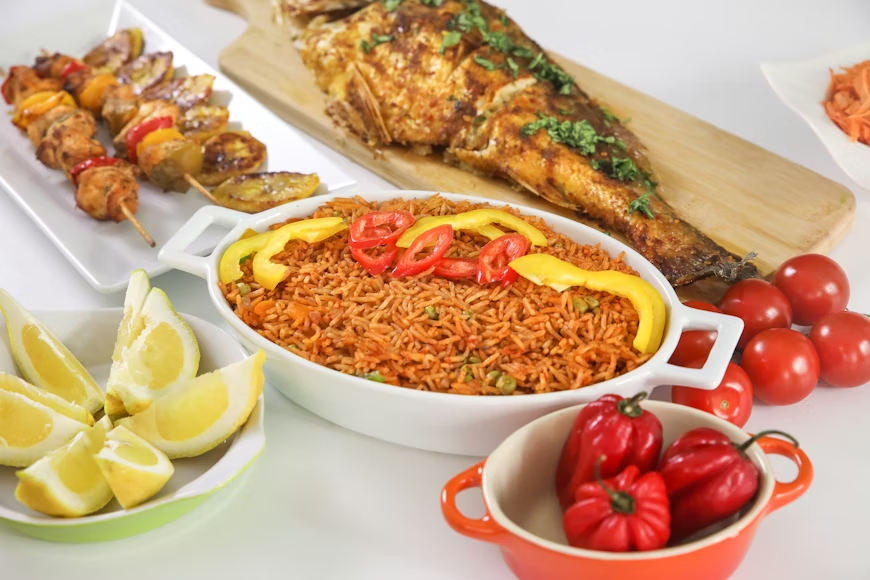
A landmark study published in the British Food Journal (1999) analyzed ten standardized Nigerian dishes and found that the energy content ranged from 281 kcal per 100g for jollof rice to 510 kcal per 100g for agbono (ogbono) soup. The other dishes studied included stewed beans with fried plantain, bean pudding, melon seed and vegetable soup, ikokore, eba imoyo, yam and eggs, and yam pottage.
The range tells an important story. At 281 kcal/100g, jollof rice is not an unusually high-calorie dish; the issue is portion size. Ogbono soup at 510 kcal/100g is denser in calories because of its fat content. The researchers concluded that these dishes are good sources of energy and protein when properly prepared and portioned.
More recently, a study on caloric restriction using Nigerian foods, published in the International Journal of Research in Medical Sciences, tested a wholly Nigerian diet on 60 patients with type 2 diabetes over 24 weeks.
The intervention group, which ate local foods in controlled calorie amounts, showed significant reductions in waist circumference (from 88.82cm to 80.0cm) and fasting blood sugar. The researchers concluded that “caloric restriction with locally available food reduced weight and normalized fasting blood sugar.” The foods were entirely Nigerian, no foreign substitutes required.
Key takeaway: Nigerian food is not incompatible with weight management. The same meals we eat every day can support calorie control, it comes down to how they are prepared and how much is on the plate.
What This Means in Practice
Based on the research, here is how to build a lower-calorie eating pattern without abandoning the Nigerian foods you love:
- Choose your soup wisely. Plain okra soup is the lowest-calorie Nigerian soup option in research. Ewedu, okra-ewedu combinations, and vegetable-based soups are your friends. Egusi and melon seed soups are significantly higher in calories because of their fat content; not off-limits, but worth moderating.
- Watch the palm oil. Research consistently shows that fat content, especially from palm oil and high-fat seeds, drives most calorie differences between Nigerian soups. Reducing oil by even a few tablespoons per pot makes a measurable difference.
- Your swallow is not the problem. At 118–138 kcal per 100g cooked, yam, cocoyam, and cassava-based swallows are moderate in calories. The portion size matters far more than the choice of swallow. A fist-sized serving of eba is not a catastrophe.
- Load up on leafy greens. African spinach, ewedu, garden egg leaves, and waterleaf are all low in calories and high in nutrients. Increasing the vegetable proportion of your soups adds volume without adding significant calories.
- The whole diet is what matters. The Nigerian diabetes study showed that locally available foods, properly portioned, can support weight loss and metabolic health. You do not need to swap rice for cauliflower rice or eba for lettuce wraps. You need reasonable portions and smarter preparation.
The Bottom Line
Nigerian food has always had the ingredients for healthy eating; we just didn’t always have the data to show it. Research from Nigerian universities and published Nigerian nutrition studies confirms what many of us suspected: our vegetables are low in calories, our staples are moderate in energy, and our soups vary widely based on how they are cooked.
The issue has never been that Nigerian food is inherently fattening. The issue is portion sizes, palm oil quantities, and eating patterns. And that is good news, because all of those things are adjustable without giving up the foods that make our tables worth sitting at.