
Nigeria’s fitness industry is growing faster than most people in it realize. If you have been thinking about starting a gym in Nigeria, 2026 is arguably the best time to do it. That said, you need to go in with accurate numbers, not rough guesses.
We at the GymSquare Research Team have put together this guide with real 2026 cost estimates, broken down by gym type. You may be considering a small neighborhood gym, a mid-size commercial facility, or a premium full fitness location. For each one, we’ll cover the costs, what you will earn, and how long it takes to break even.
The Three Levels of Gym Investment in Nigeria
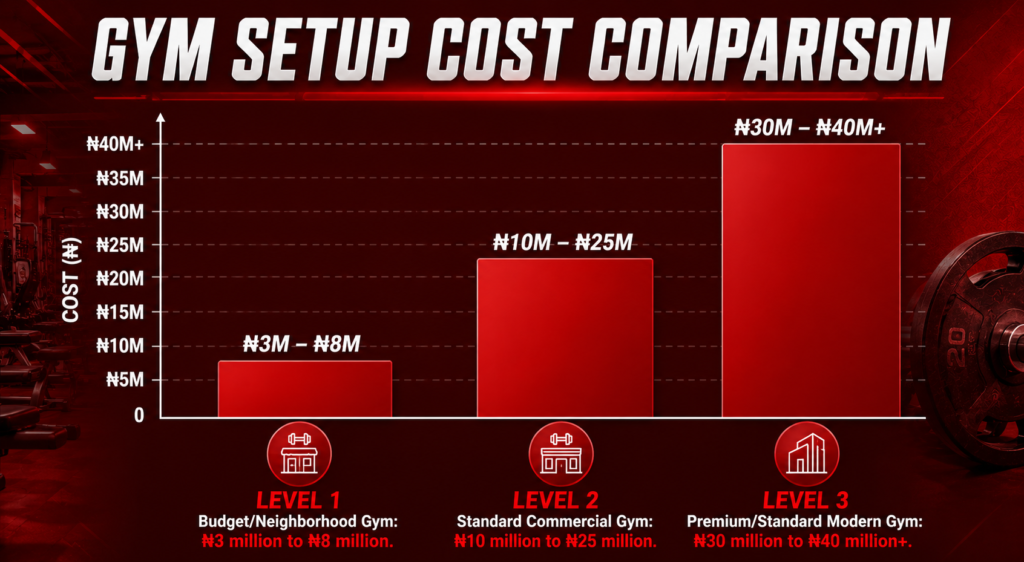
Before getting into specific numbers, it helps to understand that gyms in Nigeria operate at three distinct levels. Your startup cost, your membership price, your target market, and your potential profit all flow from the level you’re building at.
| Level 1 — Budget/Neighborhood Gym: ₦3 million to ₦8 million. Small community gym, basic equipment, local market. Think Frebson Fitness (Isolo), mid-range mainland gyms.Level 2 — Standard Commercial Gym: ₦10 million to ₦25 million. Proper commercial equipment, AC, changing rooms, and group classes. Competes in the ₦20,000 to ₦40,000 monthly membership bracket.Level 3 — Premium/Standard Modern Gym: ₦30 million to ₦40 million+. Full commercial-grade setup, imported equipment, quality finishing, spa or pool optional. Targets t-50,000 to ₦150,000 membership market in Lagos Island, Lekki, and Abuja GRA, VI. |
Our research found that the cost of setting up a standard modern gym in Nigeria is between ₦30 million and ₦40 million. This is the level that competes credibly in the premium Nigerian gym market. The breakdown below covers this level in the most detail, since it represents the most viable investment for serious operators. We also cover the lower levels for those starting smaller.
Cost Breakdown: Budget Neighbourhood Gym (₦3M–₦8M)
According to GymSquare research, the minimum required to set up a commercial gym in Nigeria is ₦5 million. At the lower end of the market, a small neighborhood gym of 80 to 150 square meters in a secondary location, here’s what the money goes on:
| Budget Gym — Approximate Cost Breakdown (₦3M–₦8M) | |
| Rent (first year + caution) | ₦800,000 – ₦2,000,000 |
| Basic commercial treadmills (3–4 units) | ₦1,200,000 – ₦2,000,000 |
| Dumbbells, barbells, benches | ₦500,000 – ₦900,000 |
| bikes/rowings/rowing machines | ₦400,000 – ₦700,000 |
| Flooring (rubber matting) | ₦150,000 – ₦350,000 |
| Mirrors | ₦100,000 – ₦200,000 |
| Air conditioning (2–3 units) | ₦400,000 – ₦700,000 |
| Renovation and painting | ₦200,000 – ₦500,000 |
| Generator + installation | ₦300,000 – ₦600,000 |
| CAC registration + permits | ₦50,000 – ₦150,000 |
| Signage, marketing, misc | ₦100,000 – ₦300,000 |
| TOTAL ESTIMATE | ₦4,200,000 – ₦8,400,000 |
This level produces a functional gym but not a premium one. Membership prices in this range, ₦8,000 to ₦15,000 per month, reflect the quality of the facility. Revenue potential is real but modest.
Cost Breakdown: Standard Commercial Gym (₦10M–₦25M)
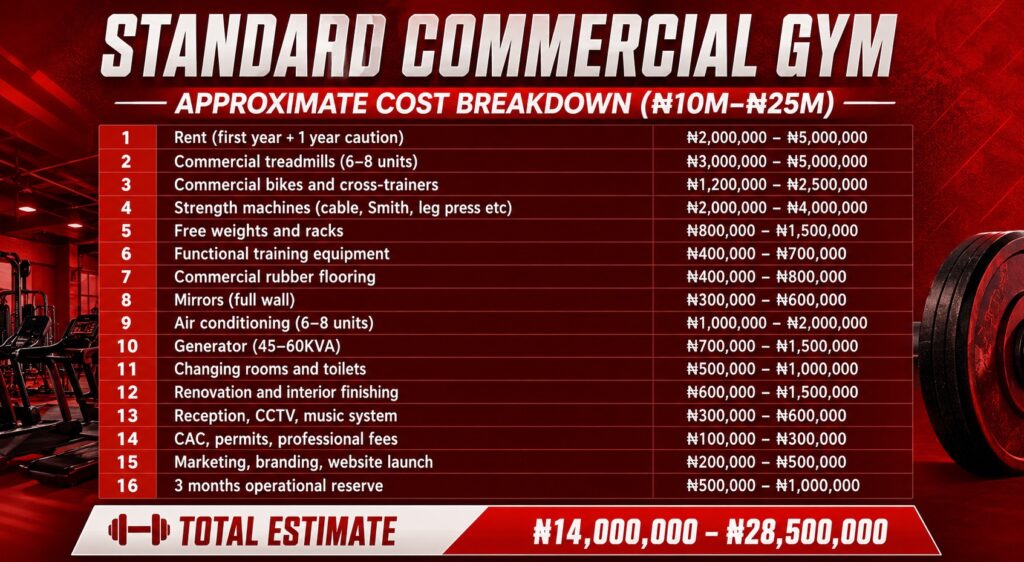
A mid-size commercial gym of 200 to 400 square meters, with proper commercial equipment, group class space, changing rooms, and professional finishing. This is the most common entry point for serious gym investors in Nigeria’s secondary cities and on the Lagos mainland.
| Standard Commercial Gym — Approximate Cost Breakdown (₦10M–₦25M) | |
| Rent (first year + 1 year caution) | ₦2,000,000 – ₦5,000,000 |
| Commercial treadmills (6–8 units) | ₦3,000,000 – ₦5,000,000 |
| Commercial bikes and cross-trainers | ₦1,200,000 – ₦2,500,000 |
| Strength machines (cable, Smith, leg press). | ₦2,000,000 – ₦4,000,000 |
| Free weights and racks | ₦800,000 – ₦1,500,000 |
| Functional training equipment | ₦400,000 – ₦700,000 |
| Commercial rubber flooring | ₦400,000 – ₦800,000 |
| Mirrors (full wall) | ₦300,000 – ₦600,000 |
| Air conditioning (6–8 units) | ₦1,000,000 – ₦2,000,000 |
| Generator (45–60KVA) | ₦700,000 – ₦1,500,000 |
| Changing rooms and toilets | ₦500,000 – ₦1,000,000 |
| Renovation and interior finishing | ₦600,000 – ₦1,500,000 |
| Reception, CCTV, music system | ₦300,000 – ₦600,000 |
| CAC, permits, professional fees | ₦100,000 – ₦300,000 |
| Marketing, branding, website launch | ₦200,000 – ₦500,000 |
| 3 months operational reserve | ₦500,000 – ₦1,000,000 |
| TOTAL ESTIMATE | ₦14,000,000 – ₦28,500,000 |
Cost Breakdown: Premium Standard Modern Gym (₦30M–₦40M+)
The ₦30 million to ₦40 million gym is the benchmark for a credibly premium facility in Nigeria. Based on GymSquare’s independent research, this is the investment level required to compete in the same bracket as established brands such as iFitness, Pure Fitness Africa, and SweatBox.
It covers a facility of 400 to 800+ square meters, with commercial-grade imported equipment, quality finishes, and infrastructure that justify membership fees of ₦40,000 to ₦100,000 per month.
| Premium Standard Gym — Approximate Cost Breakdown (₦30M–₦40M) | |
| Rent (prime location — Lagos Island, Lekki, Abuja GRA, VI) | ₦5,000,000 – ₦10,000,000 |
| Premium imported treadmills (10–15 units — Life Fitness, Precor, Technogym) | ₦5,000,000 – ₦9,000,000 |
| Commercial bikes, ellipticals, rowers | ₦2,500,000 – ₦4,500,000 |
| Full strength machine suite (8–12 units) | ₦4,000,000 – ₦7,000,000 |
| Free weights, barbells, plate-loaded racks | ₦1,500,000 – ₦2,500,000 |
| Functional training zone (battle ropes, sleds, turf) | ₦700,000 – ₦1,500,000 |
| Premium rubber and turf flooring | ₦1,000,000 – ₦2,000,000 |
| Full-wall mirrors and lighting | ₦600,000 – ₦1,200,000 |
| Industrial air conditioning | ₦2,000,000 – ₦4,000,000 |
| Generator (100KVA+) + solar backup | ₦2,000,000 – ₦4,000,000 |
| Premium changing rooms, lockers, showers | ₦1,500,000 – ₦3,000,000 |
| Reception, POS, management software, CCTV | ₦500,000 – ₦1,000,000 |
| Interior design and branding | ₦1,000,000 – ₦2,000,000 |
| Renovation and civil works | ₦1,500,000 – ₦3,000,000 |
| CAC, NAFDAC (if spa), legal, permits | ₦200,000 – ₦500,000 |
| Staff pre-opening training, uniforms | ₦200,000 – ₦500,000 |
| Pre-launch marketing and digital setup | ₦500,000 – ₦1,000,000 |
| 6 months operational reserve | ₦1,500,000 – ₦3,000,000 |
| TOTAL ESTIMATE | ₦31,700,000 – ₦63,200,000 |
The lower end of this range, ₦30 million to ₦35 million, is achievable with smart procurement: sourcing some equipment from trusted local suppliers alongside selective imports for your high-traffic machines (treadmills, cables). The upper end applies to fully imported equipment setups in prime Lagos Island or Abuja GRA locations where rent alone can run ₦8 million to ₦10 million per year.
Monthly Running Costs: What You Pay to Stay Open
The startup cost is only half the picture. Here’s what a standard commercial gym in Nigeria costs to run every month:
| Monthly Operational Costs — Standard to Premium Gym | |
| Rent (monthly equivalent) | ₦250,000 – ₦833,000 |
| Staff (3–6 trainers, receptionist, cleaner) | ₦400,000 – ₦900,000 |
| Electricity (NEPA + generator fuel) | ₦200,000 – ₦600,000 |
| Internet, music, app subscriptions | ₦30,000 – ₦80,000 |
| Equipment maintenance and repairs | ₦50,000 – ₦150,000 |
| Cleaning supplies and toiletries | ₦30,000 – ₦60,000 |
| Marketing and social media | ₦50,000 – ₦150,000 |
| Miscellaneous | ₦50,000 – ₦100,000 |
| TOTAL MONTHLY COSTS | ₦1,060,000 – ₦2,873,000 |
Electricity is one of the most underestimated costs in Nigerian gym operations. Treadmills, air conditioners, lights, and sound systems running 12 to 14 hours per day consume significant power. Most gyms run a combination of NEPA supply and diesel generator backup. At current diesel prices, a gym running a 60KVA generator for 8 hours per day in Lagos will spend more than ₦450,000 per month on fuel alone.
Revenue Potential: How Much Can a Nigerian Gym Make?
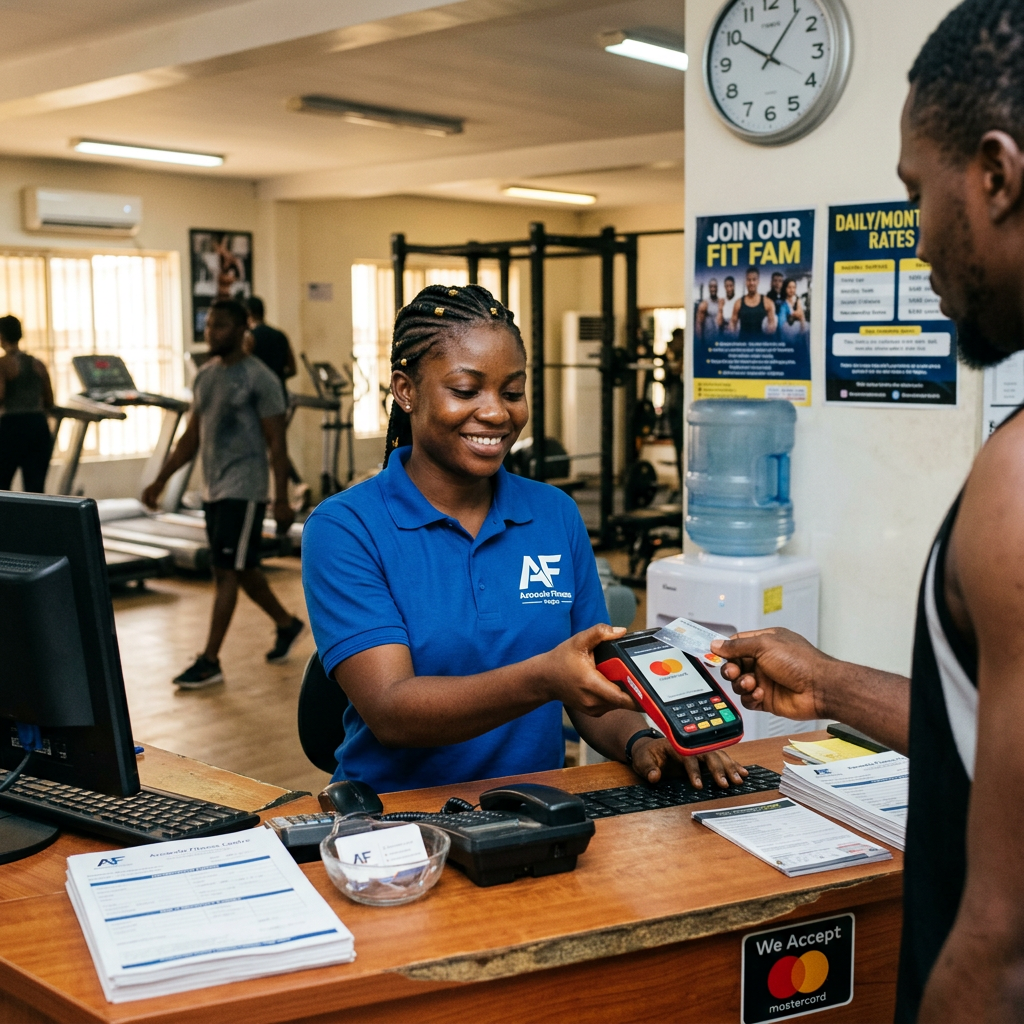
As an investor, you need to know how much you can make from a business. In that view, here’s how the revenue model works at each level, based on realistic membership numbers and Nigerian gym pricing:
| Revenue Projection — Standard Commercial Gym (200 members) | |
| Monthly membership @ ₦25,000 × 200 members | ₦5,000,000 |
| Personal training (20 clients @ ₦50,000/month) | ₦1,000,000 |
| Group classes (50 members upgrading @ ₦5,000 extra) | ₦250,000 |
| Day passes and weekly memberships | ₦100,000 – ₦200,000 |
| Supplement/merchandise sales | ₦50,000 – ₦150,000 |
| GROSS MONTHLY REVENUE | ₦6,400,000 – ₦6,600,000 |
| Less monthly running costs | (₦1,500,000 – ₦2,000,000) |
| NET MONTHLY PROFIT (estimate) | ₦4,400,000 – ₦5,100,000 |
| Revenue Projection — Premium Gym (300 members) | |
| Monthly membership @ ₦55,000 × 300 members | ₦16,500,000 |
| Personal training (40 clients @ ₦120,000/month) | ₦4,800,000 |
| Group classes, specialty programs | ₦600,000 – ₦1,000,000 |
| Spa, massage, wellness add-ons | ₦500,000 – ₦1,500,000 |
| Corporate wellness contracts (2–3 companies) | ₦500,000 – ₦1,500,000 |
| Retail (supplements, gear, accessories) | ₦150,000 – ₦300,000 |
| GROSS MONTHLY REVENUE | ₦23,050,000 – ₦25,600,000 |
| Less monthly running costs | (₦2,500,000 – ₦3,500,000) |
| NET MONTHLY PROFIT (estimate) | ₦20,550,000 – ₦22,100,000 |
Return on investment timeline: For a standard gym with a ₦20 million startup cost and ₦4.5 million monthly net profit, the full capital investment is recovered in roughly 4 to 5 months of full operation. In reality, gyms take 3 to 6 months to reach full membership capacity, so a realistic ROI timeline is 12 to 18 months.
For a premium ₦35 million gym generating ₦20 million+ in net monthly revenue, full capital recovery at capacity is possible within 2 months of full operation. However, reaching 300 members at premium prices typically takes 6 to 12 months of active marketing.
| 💡 Key investor insight: The Nigerian gym business is not a slow-return investment. At the premium level, the margin-to-investment ratio is one of the best in the Nigerian hospitality and wellness space. The challenge is not the return. Instead, it’s getting to capacity membership quickly enough. A gym with ₦35 million invested and 50 members is losing money. The same gym with 300 members is recovering its investment in months. Marketing and pre-launch membership sales are not optional. They’re the difference between the business working and not working. |
Beyond Memberships: Additional Revenue Streams
The most successful Nigerian gyms treat membership fees as a foundation, not a ceiling. Here are the additional income streams that the best operators are building:
- Personal training: This is consistently the highest-margin revenue line in any gym. A trainer charging ₦120,000 per month for 12 PT sessions has a cost to the gym of salary only. The facility, equipment, and space are already paid for. Even splitting 50/50 with a trainer, the gym earns ₦60,000 per PT client per month with zero additional overhead.
- Corporate wellness contracts: Companies such as banks, telecoms firms, and oil companies in Lagos and Abuja pay between ₦200,000 and ₦1,000,000 per month to provide their staff with gym access. This is a recurring, predictable revenue stream that doesn’t depend on individual consumer behavior. Getting two or three corporate contracts can cover your entire monthly running cost.
- Specialty classes and workshops, including yoga, pilates, kickboxing, and nutrition, are charged separately from standard membership. Members who are already paying ₦50,000 per month will pay an additional ₦15,000 to ₦30,000 per month for the classes they value.
- Supplement and merchandise retail: Selling protein powder, gym wear, and accessories on-site. Low setup cost, consistent demand from an already-captured audience.
- Gym hire and events: Renting the gym for photo shoots, fitness challenges, and brand activations. Some Lagos fitness content creators pay ₦100,000 to ₦500,000 for exclusive gym hire for shoots.
Legal Requirements: What You Need Before Opening

You can’t open a gym in Nigeria without properly registering the business. The basic legal steps are:
- CAC registration: Register your business name or company with the Corporate Affairs Commission. Cost: ₦50,000 to ₦150,000 depending on structure (sole proprietorship vs limited liability company). A limited liability company is recommended for any gym with an investment of ₦5 million.
- State business permit: Required in Lagos, Abuja, and most states. Apply through the state’s business registration office.
- NAFDAC registration: Required if you sell supplements or food products on-site.
- Fire safety certificate: Required in most states for commercial premises. Budget ₦30,000 to ₦100,000.
- Signage permit: Required in Lagos, specifically through LASAA, for any external signage.
Key Factors That Determine Success
We’ve reviewed enough Nigerian gyms to know that the equipment is rarely the reason they succeed or fail. The real determining factors are:
- Location: A gym in the wrong location will not succeed regardless of quality. Your location needs to be within 15 minutes of your target demographic. Lagos Island professionals will not drive to Ikorodu. Lekki residents will not cross the bridge for a gym. Be where your members already are.
- Consistent power supply: Members will leave a gym because of poor air conditioning more than almost any other reason. An unreliable generator or insufficient AC is a membership retention disaster. Factor the cost of reliable power into your setup properly, not as an afterthought.
- Trainer quality: Nigerians talk about their gym. A gym with knowledgeable, professional trainers gets word-of-mouth marketing that no advertising budget can buy. Pay trainers well enough to keep the good ones.
- Digital presence: The majority of Nigerian gym decisions now start online on Instagram, Google, and WhatsApp. A gym without an Instagram page in 2026 is invisible to the 25- to 40-year-old age group that drives gym membership. Build your social media presence before you open, not after.
Our Final Word
The cost of starting a gym in Nigeria in 2026 ranges from ₦4 million for a basic neighborhood gym to ₦40 million and above for a full premium facility. Based on GymSquare’s own research, the sweet spot for a credibly standard modern gym sits between ₦30 million and ₦40 million.
The returns justify the investment. A premium gym at capacity in a good Lagos or Abuja location can recover its full startup cost within 12 to 18 months and generate significant monthly profit thereafter. The fitness industry in Nigeria is not saturated — there are still far more Nigerians who want to join a quality gym than there are quality gyms to join. That gap is the opportunity.
All cost estimates are based on 2026 market pricing and GymSquare Research Team analysis. Actual costs will vary based on location, equipment sourcing, and individual business decisions. Always commission an independent feasibility study before committing capital to any gym investment.